
Zero-Trust Architecture & Hybrid Azure Clusters
Zero-Trust Architecture & Hybrid Azure Clusters establishes continuous verification across every identity, device, and workload by combining Azure Arc governance with micro-segmentation controls that isolate on-premises systems from cloud resources while maintaining unified policy enforcement.
Table of Contents
- Zero-Trust Architecture Fundamentals for Hybrid Azure Clusters
- Azure Arc Governance Under Zero-Trust Controls
- Identity Federation and Continuous Verification
- Network Segmentation and Micro-Perimeter Design
- Threat Protection and Defender for Cloud Integration
- Pro Tips from Fox Computer Solutions Team
- Common Pitfalls in Zero-Trust Hybrid Deployments
- Implementation Checklist for Hybrid Azure Clusters
Zero-Trust Architecture Fundamentals for Hybrid Azure Clusters
Zero-Trust Architecture & Hybrid Azure Clusters begins with the assumption that no network location is inherently trusted. Every request receives explicit verification regardless of origin. This model maps directly to hybrid environments where on-premises servers coexist with Azure resources under a single policy framework. In modern business practice, organizations adopt this approach to eliminate implicit trust zones that historically exposed production systems to lateral movement risks.
Core principles mapping
The three core principles of verify explicitly, least privilege access, and assume breach translate into specific Azure configurations. Verify explicitly requires identity checks at every hop. Least privilege access limits permissions to the minimum required for each workload. Assume breach drives deployment of monitoring that detects lateral movement attempts. According to industry standards, these principles reduce breach impact by containing threats within isolated segments.
Hybrid boundary definitions
Hybrid boundaries exist between on-premises clusters and Azure subscriptions. Azure Arc projects these boundaries into a unified management plane so policies apply consistently across both sides. This projection enables centralized oversight without requiring physical relocation of workloads.
Azure Arc Governance Under Zero-Trust Controls
Azure Arc Governance Under Zero-Trust Controls provides the mechanism to register and manage on-premises and multi-cloud resources from within Azure. This registration enables centralized policy application without requiring full workload migration. In real-world implementations, teams maintain operational continuity while layering governance controls progressively.
Onboarding sequence
The onboarding sequence starts with agent installation on target servers followed by assignment to an Azure Arc enabled resource group. Subsequent steps include enabling guest configuration policies that enforce baseline security settings. The sequence continues with assignment of role-based access controls that restrict actions to verified identities only.
Policy enforcement points
Policy enforcement points reside at the Azure Policy engine and the Azure Arc agent. These points evaluate compliance in real time and trigger remediation when deviations occur. Continuous evaluation ensures that any drift from defined baselines is addressed before it creates exposure.
Identity Federation and Continuous Verification
Identity Federation and Continuous Verification ensures every access request passes through Azure Active Directory before reaching cluster resources. Federation extends existing on-premises directories into Azure while preserving existing authentication mechanisms. This extension supports seamless single sign-on across hybrid boundaries without weakening verification standards.
Conditional Access configuration
Conditional Access configuration applies risk-based controls that evaluate sign-in location, device state, and session behavior before granting access to Azure Arc managed resources. Policies can block or grant access based on real-time signals such as device compliance or user risk level.
Multi-factor enforcement
Multi-factor enforcement remains mandatory for all administrative accounts that manage hybrid clusters. This requirement reduces the impact of credential compromise across both environments. Session controls further limit duration and scope of elevated access.
Network Segmentation and Micro-Perimeter Design
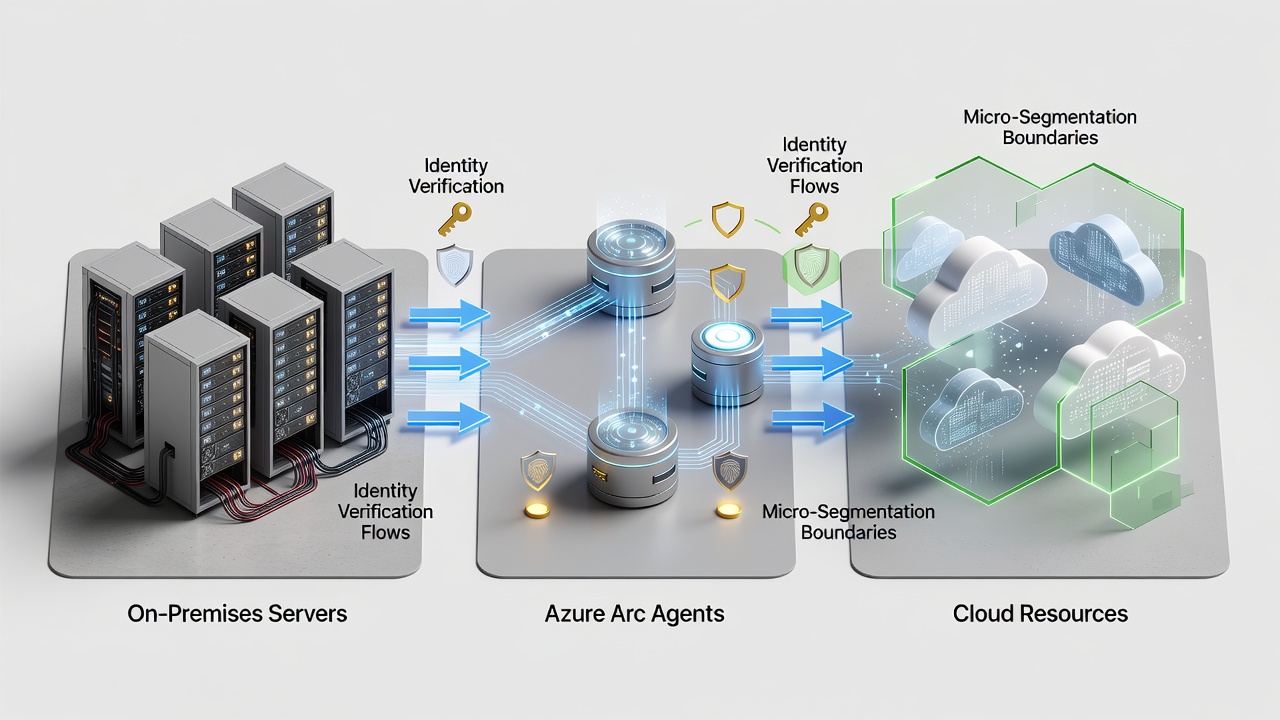
Network Segmentation and Micro-Perimeter Design isolates traffic flows so that only explicitly authorized paths exist between cluster components. This design prevents unauthorized lateral movement even when one segment becomes compromised. Segmentation policies are defined centrally and enforced at both on-premises firewalls and Azure network controls.
Threat Protection and Defender for Cloud Integration
Threat Protection and Defender for Cloud Integration extends detection capabilities from Azure into on-premises infrastructure through Azure Arc agents. Unified alerts surface across both environments for faster response. Integration creates a single pane of glass for security teams monitoring hybrid estates.
Baseline policies
Baseline policies define the minimum security posture required for cluster nodes. These policies include disk encryption requirements, update management schedules, and endpoint protection status checks. Enforcement occurs continuously through Azure Policy assignments delivered via Arc agents.
Alert response workflows
Alert response workflows route high-severity findings to security operations teams while lower-severity items trigger automated remediation actions through Azure Automation. Playbooks can isolate compromised nodes or revoke sessions automatically when thresholds are exceeded.
Pro Tips from Fox Computer Solutions Team
- Start with non-production workloads to validate policy impact before applying controls to critical production clusters.
- Maintain 24/7 monitoring dashboards that correlate Azure Arc compliance data with on-premises SIEM events for complete visibility.
- Assign a dedicated project lead who coordinates between infrastructure, security, and application teams throughout the rollout.
- Test failover scenarios regularly to confirm that zero-trust controls do not introduce unacceptable latency during recovery operations.
Common Pitfalls in Zero-Trust Hybrid Deployments
Common Pitfalls in Zero-Trust Hybrid Deployments include underestimating the scope of identity federation and neglecting to validate network paths after micro-segmentation rules are applied. Another frequent issue arises when organizations apply overly broad policies that block legitimate cluster-to-cluster communication. A common mistake businesses make is failing to update legacy service accounts that bypass Conditional Access during initial setup.
- Overly restrictive network rules that interrupt legitimate management traffic between on-premises nodes and Azure management endpoints.
- Incomplete inventory of service principals leading to orphaned identities that evade least-privilege enforcement.
- Neglecting to align on-premises certificate authorities with Azure AD certificate-based authentication requirements.
Implementation Checklist for Hybrid Azure Clusters
| Phase | Key Actions | Verification Method | Azure Tools |
|---|---|---|---|
| Assessment | Inventory all cluster nodes | Policy compliance scan | Azure Arc |
| Identity Setup | Configure Conditional Access | Sign-in logs review | Azure AD |
| Network Controls | Apply micro-segmentation | Traffic flow validation | Private Link |
Frequently Asked Questions
What are the first three steps to apply zero-trust to an existing Azure Arc cluster?
Begin with a full inventory of cluster nodes and workloads, enable Azure Arc governance policies, then enforce Conditional Access rules across all identities.
How does Azure Defender integrate with on-premises zero-trust controls?
Azure Defender for Cloud extends threat protection baselines to on-premises resources through Azure Arc agents, providing unified alerts and automated response workflows.
Which network services enforce micro-perimeters in hybrid setups?
Azure Private Link combined with ExpressRoute circuits and network security groups creates enforceable micro-perimeters that isolate traffic between on-premises systems and cloud resources.
Connect with a Specialist for Zero-Trust Architecture & Hybrid Azure Clusters here.
Related services: Cloud Services | Cybersecurity | Network Implementation
