

Azure hybrid migration checklist for factories delivers a structured sequence of steps that manufacturers follow to connect PLC and SCADA systems to Microsoft Azure hybrid environments while preserving continuous production uptime in 2026.
Table of Contents
- Azure Hybrid Migration Checklist for Factories: Core Capabilities
- Step-by-Step Technical Specification Matrix for PLC and SCADA Integration
- Zero-Downtime Migration Pathways Validated for Industrial Systems
- Common Pitfalls When Selecting Azure Hybrid Migration Providers
- Pro Tips from 25 Years of Central Florida Manufacturing IT Experience
- Frequently Asked Questions
Azure Hybrid Migration Checklist for Factories: Core Capabilities
Azure hybrid migration checklist for factories starts with continuous monitoring through a local Network Operations Center that tracks every production line asset in real time. Production Line Monitoring Protocols rely on dedicated sensors and agents that watch PLCs, SCADA networks, and ERP connections so any deviation triggers immediate escalation to on-call engineers. Rapid Response SLAs for Shift Operations guarantee response under 15 minutes for critical production halts and under 60 minutes for non-critical alerts to minimize lost output during all three shifts throughout 2026.
Factories in the Orlando region gain immediate visibility into every industrial control asset when the checklist begins with asset inventory and protocol mapping. The first checklist step requires cataloging every PLC model, firmware version, and SCADA communication path before any migration activity starts. The second checklist step maps each protocol such as Modbus, OPC UA, and EtherNet/IP to the corresponding Azure IoT Hub or Azure Arc endpoint. The third checklist step establishes encrypted VPN staging layers that isolate production traffic from migration test traffic. The fourth checklist step validates firewall rules and certificate chains on both the factory side and the Azure side. The fifth checklist step runs parallel monitoring dashboards that compare on-premises performance metrics with cloud-side telemetry before any workload shift occurs.
Additional checklist items continue through the sixth step of conducting bandwidth testing during peak shift hours to confirm that VPN capacity supports full SCADA polling rates. The seventh checklist step creates rollback scripts that restore PLC logic and SCADA screens within five minutes if any validation checkpoint fails. The eighth checklist step documents every change in a centralized change-management log accessible to both plant engineers and the remote operations center. The ninth checklist step schedules quarterly tabletop exercises that rehearse full production outages using the same rollback scripts. The tenth checklist step verifies that all ERP interfaces remain synchronized after each incremental workload migration. The eleventh checklist step confirms that alarm prioritization rules in the Azure monitoring portal match existing factory alarm hierarchies. The twelfth checklist step tests multi-shift handoff procedures so that overnight teams receive the same sub-15-minute response coverage. The thirteenth checklist step audits every legacy device for unsupported cipher suites that could block Azure hybrid connectivity. The fourteenth checklist step validates that historian data replication to Azure Data Lake occurs without latency spikes during normal production. The fifteenth checklist step closes the migration by running a final end-to-end production simulation that exercises every PLC, SCADA screen, and ERP transaction under load.
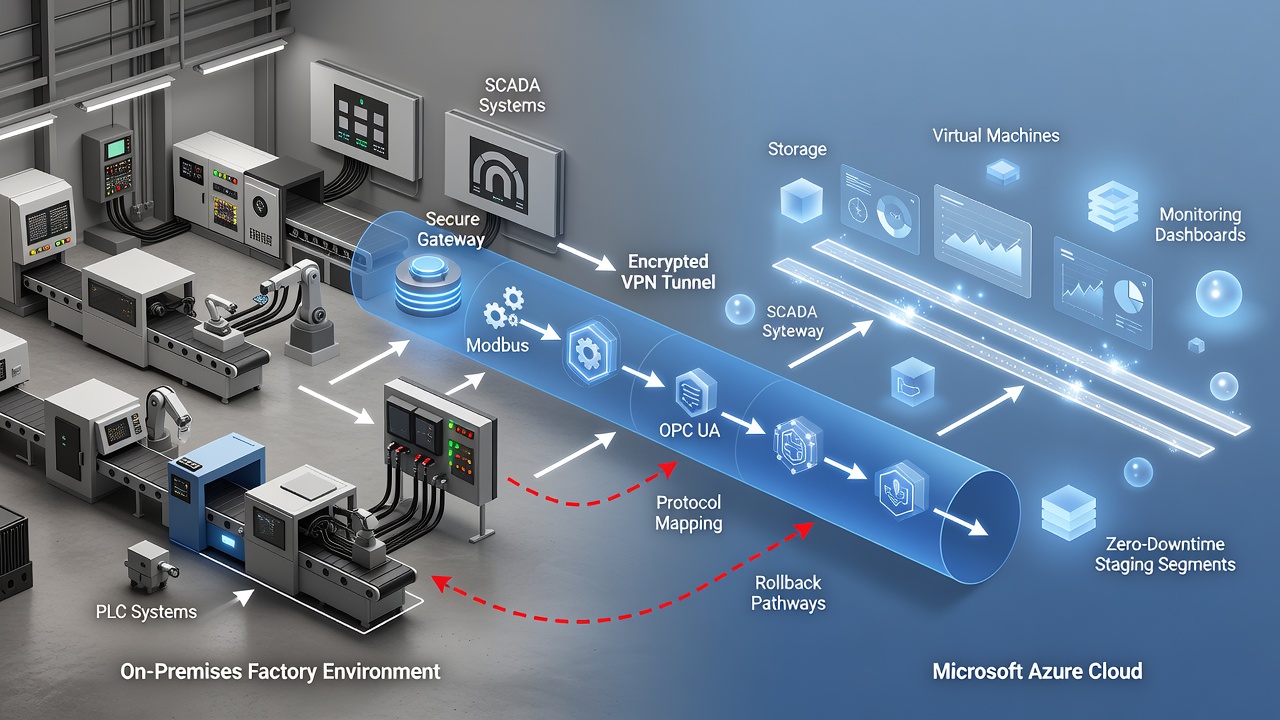
Step-by-Step Technical Specification Matrix for PLC and SCADA Integration
Step-by-step technical specification matrix for PLC and SCADA integration begins with a clear definition of each required connection parameter before any configuration work starts. The matrix first row lists PLC model, firmware version, supported protocols, required Azure endpoint, encryption standard, and validation test. The matrix second row documents SCADA server operating system, historian database version, polling frequency, and the exact Azure Arc agent installation path. The matrix third row records network segmentation rules that separate production VLANs from migration test VLANs while allowing monitored traffic flow. The matrix fourth row specifies certificate authority chains and certificate rotation schedules that both the factory and Azure must honor. The matrix fifth row defines rollback thresholds such as maximum acceptable latency before automatic reversion to on-premises control occurs.
Factories complete the matrix by populating each cell with measured values obtained during the asset inventory phase. Protocol compatibility checks confirm that legacy Modbus RTU devices can traverse the VPN without packet fragmentation. SCADA screen rendering tests verify that operator displays refresh within the same time limits after the historian moves to Azure. Bandwidth calculations inside the matrix confirm that peak shift polling rates remain below 70 percent of available VPN capacity. Security baseline entries inside the matrix list every open port, required cipher suite, and certificate expiration date. Validation columns inside the matrix record pass or fail results for each test case before the next migration phase begins.
Zero-Downtime Migration Pathways Validated for Industrial Systems
Zero-downtime migration pathways validated for industrial systems follow a phased sequence that keeps every PLC and SCADA loop under local control until the final cutover moment. Phase one establishes the encrypted VPN and parallel monitoring layer without moving any control logic. Phase two migrates historian data replication to Azure while production continues to write to the local historian. Phase three shifts non-critical reporting workloads to Azure virtual machines while alarm handling remains on-premises. Phase four moves alarm aggregation and notification services to Azure while keeping final actuation commands local. Phase five executes the final cutover of control loops after all validation checkpoints report green status.
Each phase includes explicit checkpoints that plant engineers must sign before the next phase starts. The first checkpoint confirms that VPN latency stays below 10 milliseconds during full production load. The second checkpoint verifies that historian replication lag never exceeds 30 seconds. The third checkpoint tests that SCADA screen updates remain identical on both local and Azure dashboards. The fourth checkpoint runs a simulated production batch that exercises every PLC logic path. The fifth checkpoint confirms that rollback scripts restore full local control within five minutes. The sixth checkpoint documents that all ERP transactions completed successfully during the test window. The seventh checkpoint records operator feedback that alarm visibility and response times match pre-migration baselines.
| Support Tier | Response Time | Azure Integration | On-Site Availability |
|---|---|---|---|
| Essential | Under 60 minutes | Monitoring only | Next business day |
| Production Critical | Under 15 minutes | Full hybrid management | Same shift |
Common Pitfalls When Selecting Azure Hybrid Migration Providers
Common pitfalls when selecting Azure hybrid migration providers include choosing vendors that lack true 24/7 local staffing or industrial protocol experience. Many Orlando manufacturers discover after contract signing that the provider cannot deliver sub-15-minute response during overnight shifts. Providers without validated zero-downtime pathways for PLC and SCADA systems often cause extended production interruptions when unexpected protocol incompatibilities appear. Another frequent error occurs when vendors skip the quarterly tabletop exercise requirement, leaving plant teams unprepared for coordinated recovery during an actual incident. Selecting a provider that does not maintain a local Network Operations Center in Central Florida removes the ability to send technicians to the plant floor within the same shift when hardware faults occur.
Pro Tips from 25 Years of Central Florida Manufacturing IT Experience
Experienced teams in Central Florida manufacturing plants have observed that quarterly tabletop exercises must include every shift supervisor and every on-call engineer to be effective. These exercises reveal gaps in rollback procedures that only surface when the entire production line stops at 2 a.m. Another observed pattern shows that legacy PLCs using older Modbus implementations frequently require additional protocol converters before Azure Arc agents can read tags reliably. Teams that document every certificate expiration date in a shared calendar avoid last-minute outages when certificates expire during a critical production week. Plants that run parallel historian replication for at least 30 days before cutover catch data-integrity issues that would otherwise appear after migration completes. Operators who practice alarm response using the Azure dashboard during the parallel phase adapt faster once the final cutover occurs.
Frequently Asked Questions
What is Azure hybrid migration for manufacturing? Azure hybrid migration connects on-premises PLC and SCADA systems to Microsoft Azure while maintaining production uptime.
How does Azure hybrid migration prevent manufacturing downtime in Orlando? Azure hybrid migration prevents manufacturing downtime in Orlando by maintaining a dedicated 24/7 NOC that monitors production systems in real time and delivers sub-15-minute response for critical outages.
What makes Longwood managed IT different for local factories? Longwood managed IT combines on-site technicians with remote monitoring to protect Orlando area production lines while supporting hybrid Azure environments.
Can Winter Park cloud solutions integrate with existing PLC systems? Yes. Winter Park cloud solutions are designed to connect securely with legacy PLC and SCADA systems common in Central Florida manufacturing plants.
Book your free IT strategy session for 2026 Azure migration planning to protect your production schedule.
